Interlude.Compute.Arithmetic
In Depth
Compute.Arithmetic(left, operation, right)
Arithmetic on two values. Each side is either a field key or a nested computation. Dividing by zero gives zero rather than infinity, so a half-filled form shows a sensible total instead of a symbol.
The inputs are:
left(object) — A field key, a literal, or a nested computation.operation(string) — Add, Subtract, Multiply, Divide, Modulo, Power, Min or Max.right(object) — A field key, a literal, or a nested computation.
Returns computation — The computation.
Search terms: arithmetic, math, multiply, divide, subtract, calculate.
About the Compute nodes
Values worked out from other answers, for use with Behavior.WithComputed.
A computed field is driven by the form rather than by the user: it recalculates whenever anything it reads changes, in dependency order, so a total built on a subtotal is always consistent. Computed values that depend on each other in a loop are rejected when the form is built, before a window appears.
Example File
An example graph ships beside this page: Interlude.Compute.Arithmetic.dyn

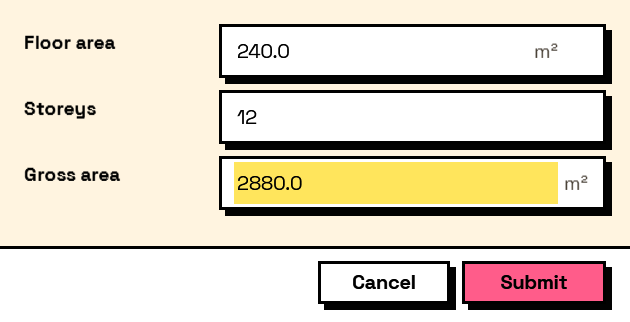
The form it builds: