Interlude.Result.GetColor
In Depth
Result.GetColor(result, key)
A colour answer, broken out as hex and as numbers on separate ports.
Both forms come out at once — the hex string, and red, green, blue and alpha as numbers from 0 to 255 — because the node that wants a colour next might want either, and converting between them in a graph is tedious.
Take the numbers to build a Revit or Dynamo colour; take the hex to write a parameter, a filename or a stylesheet.
The inputs are:
result(object) — The values dictionary or the form output of Form.Show.key(string) — The field to read.
The outputs are:
hex— The colour as "#RRGGBB", or "#AARRGGBB" when it is not fully opaque.red— Red, 0 to 255.green— Green, 0 to 255.blue— Blue, 0 to 255.alpha— Opacity, 0 to 255.
Search terms: colour, color, hex, rgb, argb, get, read.
About the Result nodes
Reading a form's answers.
Every node here accepts either the values dictionary or the form output of Form.Show, so it does not matter which one is to hand. They exist so a graph can say what it expects — a number, a date, a colour — rather than pulling an object out of a dictionary and hoping. Each one takes a fallback used when the field is missing or empty, which is what keeps a downstream node from receiving a null it was not expecting.
Example File
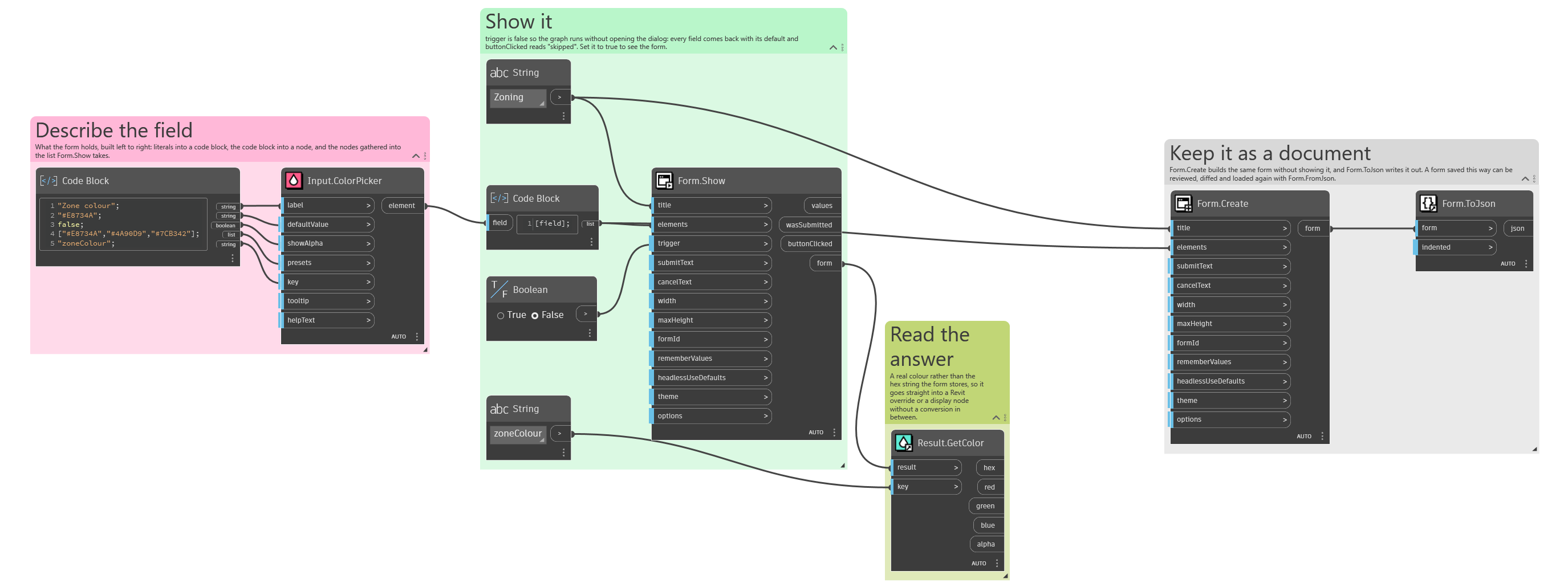
An example graph ships beside this page: Interlude.Result.GetColor.dyn
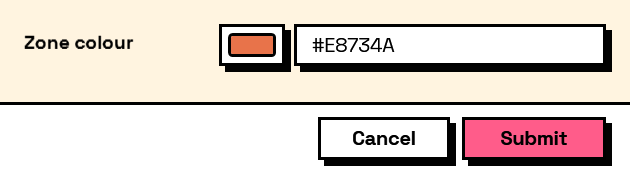
The form it builds: