Interlude.Rule.Range
In Depth
Rule.Range(minimum: null, maximum: null, message: "")
The field's number must fall between the bounds. Either bound can be left out for a one-sided range.
Both ends are inclusive: a range of 1 to 10 accepts 1 and accepts 10.
Worth knowing when this is the right tool. Input.Number's own minimum and maximum stop an out-of-range value being typed, which is a better experience where it applies. This is for the cases that cannot: a bound that depends on another field, or a number arriving in a text box.
The inputs are:
minimum(object, defaults tonull) — Lowest acceptable value.maximum(object, defaults tonull) — Highest acceptable value.message(string, defaults to"") — Wording shown when it does not.
Returns rule — The rule.
Search terms: range, between, minimum, maximum, bounds, limit.
About the Rule nodes
Checks applied to a field's answer, for use with Behavior.WithValidation.
Rules run as the user types and block submission while any of them fails. A rule on a field the user cannot see is never applied — a hidden field can never stop a form being submitted, which would otherwise mean an error with no control to fix it.
Except for Rule.Required, every rule passes on an empty field. Emptiness is Behavior.Required's business, so an optional field with a range on it stays optional.
Example File
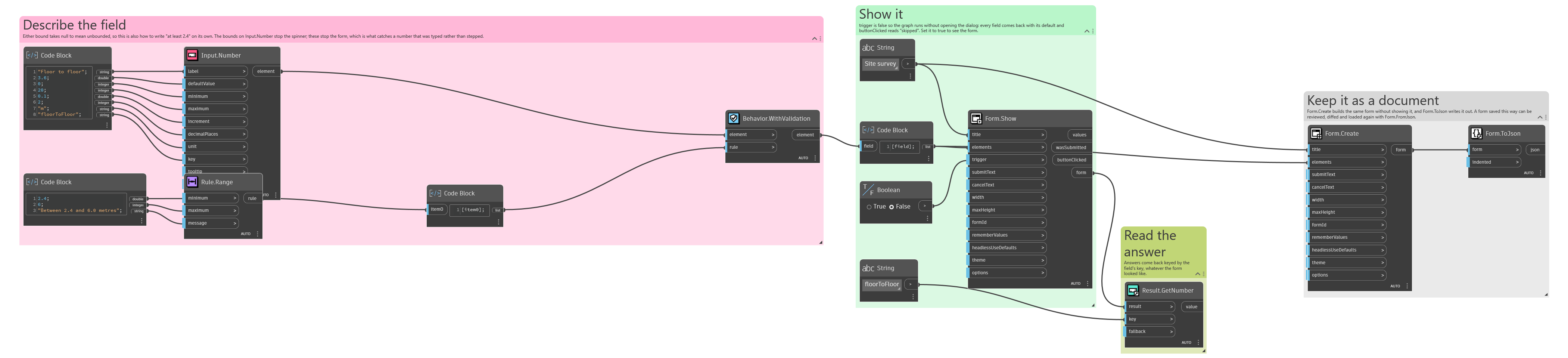
An example graph ships beside this page: Interlude.Rule.Range.dyn
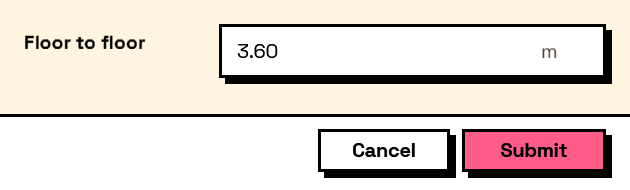
The form it builds: