Interlude.Input.TreeItem
In Depth
Input.TreeItem(displayName, value: null, children: null, expanded: false, selectable: true)
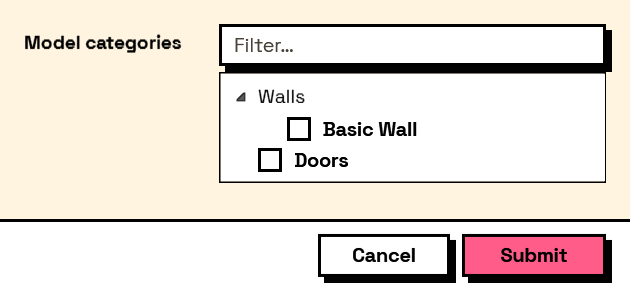
One item of a tree, for Input.TreeSelect.
Build a hierarchy by feeding items into a parent's children port, as deep as you like. This is the only Input node that does not produce a form element on its own: it is the material Input.TreeSelect is made of, and placing it anywhere else does nothing.
value is what selecting the item returns, and falls back to the display name when left empty — so a tree of plain strings needs nothing else, while a tree of Revit elements carries them through untouched.
The inputs are:
displayName(string) — What the user reads.value(object, defaults tonull) — What choosing this item returns. Falls back to the display name.children(list of object, defaults tonull) — Items nested beneath this one.expanded(boolean, defaults tofalse) — Whether this item starts open.selectable(boolean, defaults totrue) — False for a branch that only groups its children.
Returns treeItem — The tree item.
Search terms: tree, item, node, branch, leaf.
About the Input nodes
The fields a user answers.
Every input returns an element describing the control, not the control itself, and every one takes the same three trailing options: key, which names the answer in the results dictionary; tooltip; and helpText. Leave key empty and it is derived from the label — convenient for a quick form, but give real keys to any graph you intend to keep, because renaming a label would otherwise rename the answer.
Choice inputs take the values themselves, not their display names. Selecting an option hands back the original object — a Revit element, a family type, whatever was put in — so the answer is usable directly instead of needing a lookup back from a string.
Example File
An example graph ships beside this page: Interlude.Input.TreeItem.dyn

The form it builds: