Interlude.Rule.Required
In Depth
Rule.Required(message: "")
The field must have an answer.
The exception to the family rule: every other rule passes on an empty field and this one is the reason they can, because emptiness is dealt with here rather than in each of them.
Behavior.Required does the same job in one node and adds the asterisk beside the label, which is what a user actually reads. Reach for this one when the requirement needs wording of its own, or when it is going into a list of rules alongside others.
The inputs are:
message(string, defaults to"") — Wording shown when it does not.
Returns rule — The rule.
Search terms: required, mandatory, not empty, must.
About the Rule nodes
Checks applied to a field's answer, for use with Behavior.WithValidation.
Rules run as the user types and block submission while any of them fails. A rule on a field the user cannot see is never applied — a hidden field can never stop a form being submitted, which would otherwise mean an error with no control to fix it.
Except for Rule.Required, every rule passes on an empty field. Emptiness is Behavior.Required's business, so an optional field with a range on it stays optional.
Example File
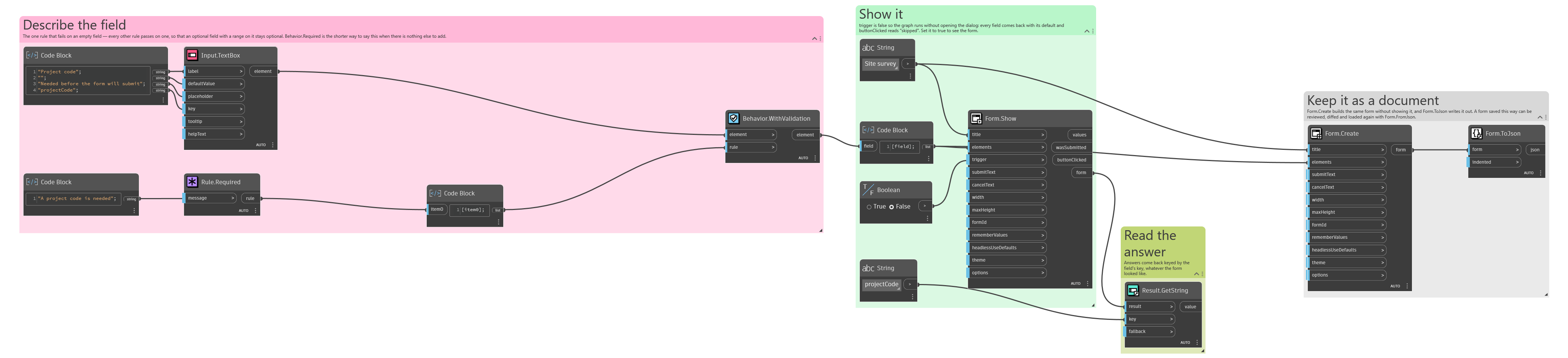
An example graph ships beside this page: Interlude.Rule.Required.dyn
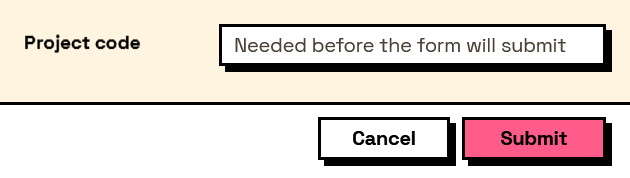
The form it builds: